Why we made it
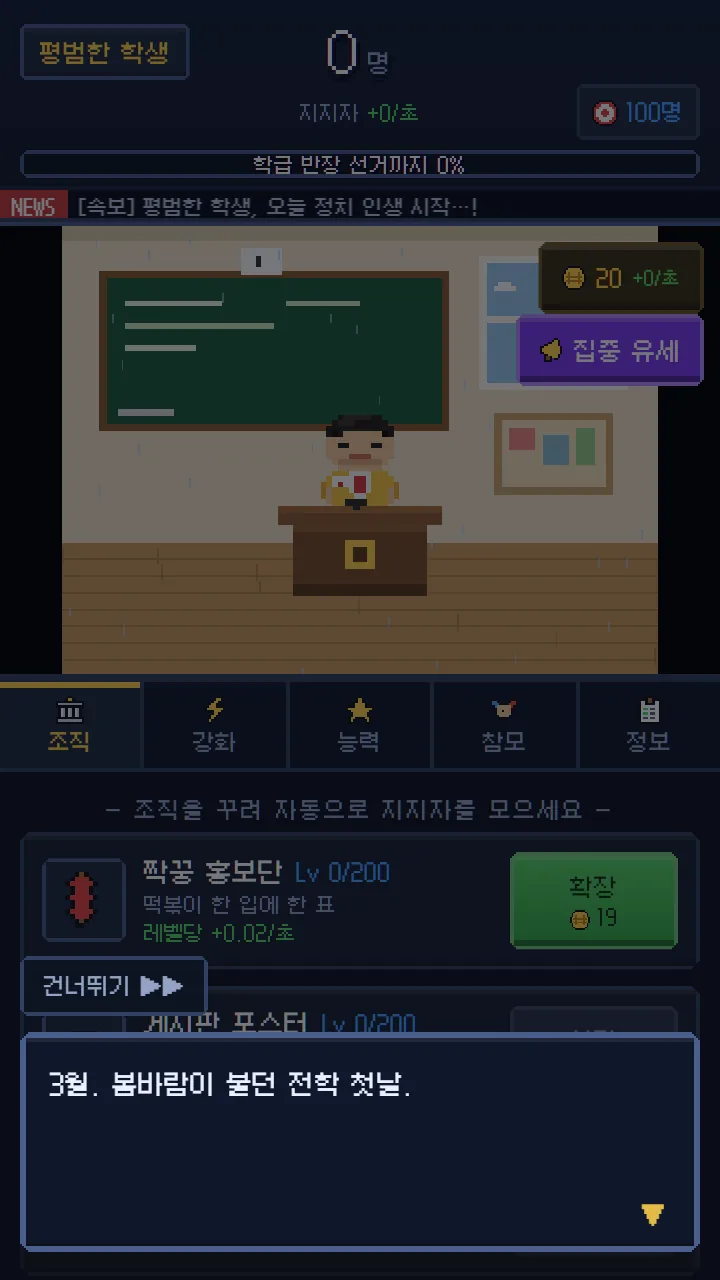
The game begins like this: “March. My first day at a new school, a spring breeze in the air. Nobody knows my name. My self-introduction at the blackboard was over in 3 seconds.”
Everyone remembers at least one class president election. Campaign promises with tteokbokki on the line. Names on the blackboard, and votes tallied stroke by stroke into the character 正. We wanted to start from that smallest of elections and tell a story that climbs, one step at a time, to the biggest seat of all — with the hands-on fun of an idle raising game.
So let us be clear up front. This is not a political game. It's an idle raising game that only borrows the presidency as its theme. We say so on the game's very first screen, too — “This game does not depict or support any particular political group or politician. Everything in it is fiction; please enjoy it only as a game.”

Idle games: a few scenes
Games that keep growing even when you leave them alone are usually called idle games. Resources pile up little by little, automation makes them grow faster and faster, and the game even takes care of the progress made while it's switched off (Wikipedia). Out of countless games, we touch on just a few scenes that come up often.
Progress Quest, released by Eric Fredricksen in early 2002, was a game with nothing left to do once you'd made your character. The game ‘plays’ all on its own, and you just watch. It was a parody that gave online role-playing games a twist (Wikipedia). Ian Bogost's Cow Clicker, from July 2010, was a game where you click a picture of a cow once every six hours — a satire poking at social games (Wikipedia).
The scene that became the face of the genre is Cookie Clicker, made by Orteil (Julien Thiennot) on August 8, 2013. IGN counted it among the few games that established the idle genre, and in September 2021 it came to Steam as well (Wikipedia). In 2014, Hyper Hippo's AdVenture Capitalist started out on browsers and Android, crossed over to iOS and PC the next year, and made it all the way to PlayStation 4 in 2016 (Wikipedia).
In Korea, the genre took on another face under the name ‘raising’. Manababa's Beggar Life(거지키우기) series is a raising game that mixes idle and clicker play (App Store, Beggar Life 3), and in January 2016 GameMeca reported that the first game was a popular hit with more than 1 million downloads (GameMeca, 2016-01-14). Abyssrium, first released that same year, 2016, is a game where you tap the screen to grow an aquarium of your own (App Store), and it has recorded 65 million downloads (Byline Network, 2024-06-19).
Put them side by side, and what gets raised keeps changing: a character that plays by itself, one cow, a tray of cookies, one beggar, one aquarium. What Pixel Politics raises is supporters, and the click is a handshake.
What we kept, what we changed
Tap and it grows, leave it and it piles up, and what piles up opens something bigger — we kept this idle loop just as it is. What we changed is what sits on top of the loop.
- Taps are handshakes — Every tap on the screen is a handshake, and your supporters grow by one. Shake hands 100 times and you earn the achievement ‘Handshake Beginner’.
- Auto-production is your organization — You build up organizations that gather supporters for you. From the ‘Deskmate PR Squad’, which trades one bite of tteokbokki for one vote, to ‘Club Coalition Support’, collecting votes one by one from the band club to the Go club, all the way to the ‘Summit Diplomatic Corps’, which establishes diplomatic relations with a single handshake — thirteen organizations are on view, and one is still a question mark.
- Bursts are campaign blitzes — Set off a combo with a campaign blitz, and all production runs at 1.8× for 45 seconds.
- Stages are elections — When your supporters reach the goal, you can run in an election. This is where we added a moment of decision to the idle formula.
The first election is for class president. Your opponent is different every time; this time it's ‘Tteokbokki-Pledge Park Tteokbo’. Your projected chance of winning appears on screen, and you pick one of three: go to the debate and let public opinion decide, go straight to the count, or prepare a little more. But the longer you drag it out, the stronger your opponent gets, and if you lose, 15% of your supporters walk away. It's a game that grows even when you leave it alone, but where to make your stand is your call.


From class president to what comes next
Every election you win takes you up one step. From the classroom to the school, on through town and region, all the way to the nation — it's eleven steps from ordinary student to President. What opens up once you become President, we've left as a question mark, even inside the game. Climb up and see for yourself.
Staff, the collection, and March all over again
Staff — No one runs an election alone. For the staff, we wanted to add a touch of strategy, like Romance of the Three Kingdoms. Seat staff in the Cabinet on the Staff tab, and your handshakes and donations, your organizations' output and your chance of winning all go up. You start with only two seats, but more open as your rank rises, until you can fill seven. That's why recruiting is a matter of ‘Pick and Appoint’ (골라 등용), too: you pick one of three candidates, and if none of them suits you, you scout for other talent. Staff fall into five roles — PR, finance, organization, strategy and management — and four grades: Common, Rare, Heroic and Legendary. Characters from the story sometimes join as special staff, too: your deskmate Minji as chief of staff, and your mom as fundraising chair. Seat PR, finance and organization evenly for a ‘Triangle Formation’, or fill the whole Cabinet for a ‘Complete Cabinet’ — combinations bring synergies, too.
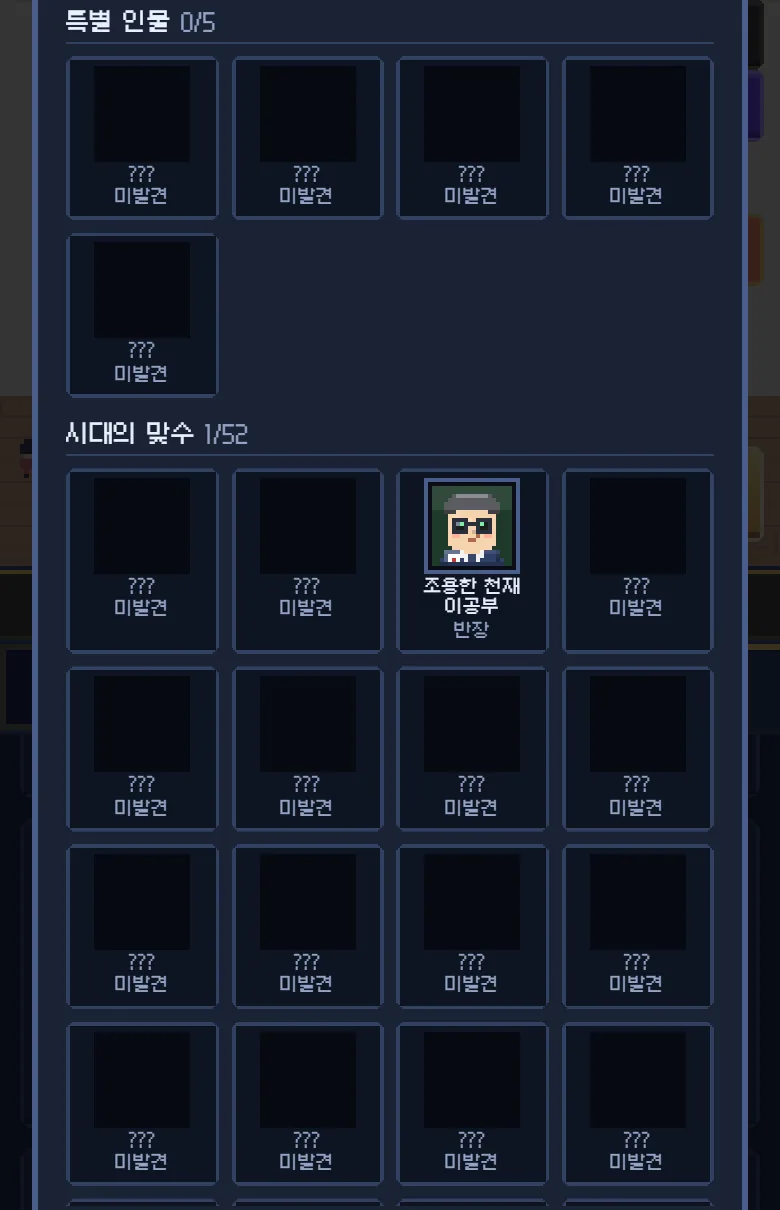
Character Collection — The opponents you face in elections and the people you meet on campaign outings stay in your character collection. Special figures, rivals of the era, people on the street: 100 people in all. It fills in one slot at a time, starting with your opponent in the first class president election, and each time you reach 25%, 50%, 75% and 100%, your overall production goes up for good.

Second run and beyond — Once you become President, you can retire and start a new run. Your deskmate Minji says, “It's March again.” Back to the first classroom, back to the class president election — but not empty-handed. With know-how points, which pile up the further you go, you permanently build up Startup Funds, Prepared Candidate, Delegated Rule, Field Master and Organization Network, and your character collection and records carry over from run to run. An opponent who once beat you comes back as a nemesis, and if you finally beat them, they're sealed away. A sealed nemesis becomes an ally in your next run and shows up again on your outings. Each run also brings new challenge goals. All so that you climb the same ladder again, yet every climb becomes a slightly different story.
A spoonful of laughs
A news ticker runs across the top of the screen: “[Economy] Tteokbokki index on the rise, up 3.2%”, “[Society] Petition for a stray-cat snack ordinance passes 100,000”, “[Sports] Citizens cheer as local baseball team snaps 9-game losing streak”. The one-liner on each organization is in the same vein: ‘Dues accepted in spirit only (official)’, ‘Hauling coal briquettes, and hauling in votes’. Because we borrowed a heavy subject, we made the screen light and a little quirky.
We hope a story that starts with one handshake becomes a small joy for someone, growing a little with every break they take.
How to play
- Tap the screen to shake hands and gather supporters.
- Expand your organizations, and supporters keep coming even while you sit still.
- Set off a combo with a campaign blitz, and production surges for a while.
- Reach your supporter goal, then Run for Election! — win, and you climb to the next step.
Sources — Incremental game (Wikipedia) · Progress Quest (Wikipedia) · Cow Clicker (Wikipedia) · Cookie Clicker (Wikipedia) · AdVenture Capitalist (Wikipedia) · Beggar Life 3: Real Estate (App Store) · Beggar Life Christmas Edition, 2016-01-14 (GameMeca) (in Korean) · Abyssrium - the aquarium you grow by tapping (App Store) · Abyssrium The Classic released, 2024-06-19 (Byline Network) (in Korean) · Game screens: captured from the web build, October 4, 2026