Why we made it
You may have drawn boxes in pen on the grid of a maths notebook. One cell, then another on top of it. How high can a doodle stacked along the grid go?
A ‘perch’ is the branch or ledge a bird rests on, and also a high, prominent position (Wiktionary). The game’s subtitle is ‘A place on paper’. A game where every pen-drawn block finds its own place on a narrow stand — that is where Paper Perch began.
Stacking is a game everyone knows. So we had one question. How do you put a new variation on stacking, a game everyone knows? What you stack, why you stack, who you stack with — we decided to change them one at a time.
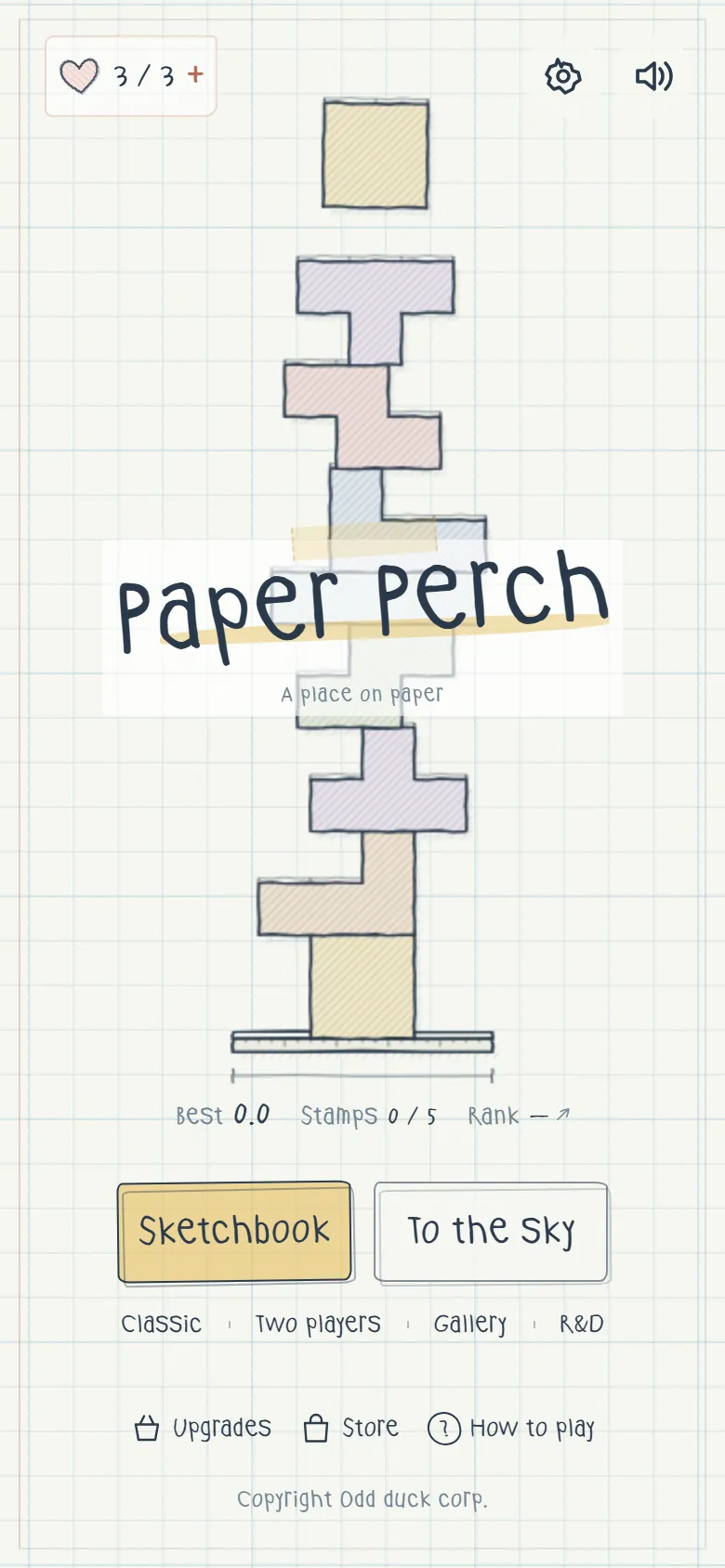
So many stacking games, a few scenes
There are countless stacking toys and games. Lining them up by who came first and what followed what is hard. Here we look at only a few scenes people often talk about.
In January 1983, Leslie Scott’s Jenga was launched at the London Toy Fair. You pull one block at a time from a tower of 54 and put it on top, and the game ends when the tower falls. The name comes from the Swahili word kujenga, ‘to build’ (Wikipedia). In the mid-1980s, Alexey Pajitnov made Tetris at the Dorodnitsyn Computing Center of the Soviet Academy of Sciences. Seven pieces of four squares each — the tetrominoes — fall while you rotate and move them, and a completed line disappears (Wikipedia).
On phones there was Digital Chocolate’s Tower Bloxx in 2005: you timed the drop of floors swinging side to side from a crane to raise a building (Wikipedia). Tricky Towers, in August 2016, gave tetrominoes physics. Rows never disappear, and blocks can fall off the tower. As wizards casting spells at each other, players race to build the tallest, sturdiest tower the fastest (Wikipedia). どうぶつタワーバトル (Animal Tower Battle), released in March 2017, stacked animals instead of blocks. Two players take turns, and whoever drops one first loses (Wikipedia, in Japanese).
Put side by side, what each one changed stands out more than which came first. Jenga pulled blocks out and put them on top, Tetris filled lines and cleared them, Tower Bloxx dropped floors from a swinging crane, Tricky Towers added physics and magic, and Animal Tower Battle changed what you stack. On the same idea of stacking, the pieces, the hand and the opponent kept changing.
What we kept, what we changed
Put the blocks on one at a time, and the game ends if any of them falls — we kept that skeleton. Side by side with the games above, it looks like this.
| Game | What you stack | What your hand does |
|---|---|---|
| Jenga (1983) | 54 wooden blocks | pull one out and put it on top |
| Tetris (mid-1980s) | 7 tetrominoes | rotate and move the falling piece |
| Tower Bloxx (2005) | floors of a building | time the drop from a swinging crane |
| Tricky Towers (2016) | tetrominoes with physics | stack without toppling · cast spells at each other |
| Animal Tower Battle (2017) | animals | tap to rotate, slide to move, let go to drop |
| Paper Perch | pen-drawn blocks | hold to stop a block that spins by itself, drag to move, let go to drop |
In Paper Perch the block spins by itself. Holding it still the moment the angle you want comes round — that one beat of timing is how this game feels in the hand. And each mode changes one thing.
- Classic — the base game. Hold to stop at the angle you want, slide left or right, and let go. If any block falls, it is over. Only Classic records enter the height rankings.
- Sketchbook journey — changes the goal. Instead of height, you fill more than 70% of a sketch drawn in the notebook with blocks. There are six notebooks — On the desk, Moving day, The garage, The nursery, Sweet shop and Sea diary — of 16 pages each, and every page has something to make and something in the way.
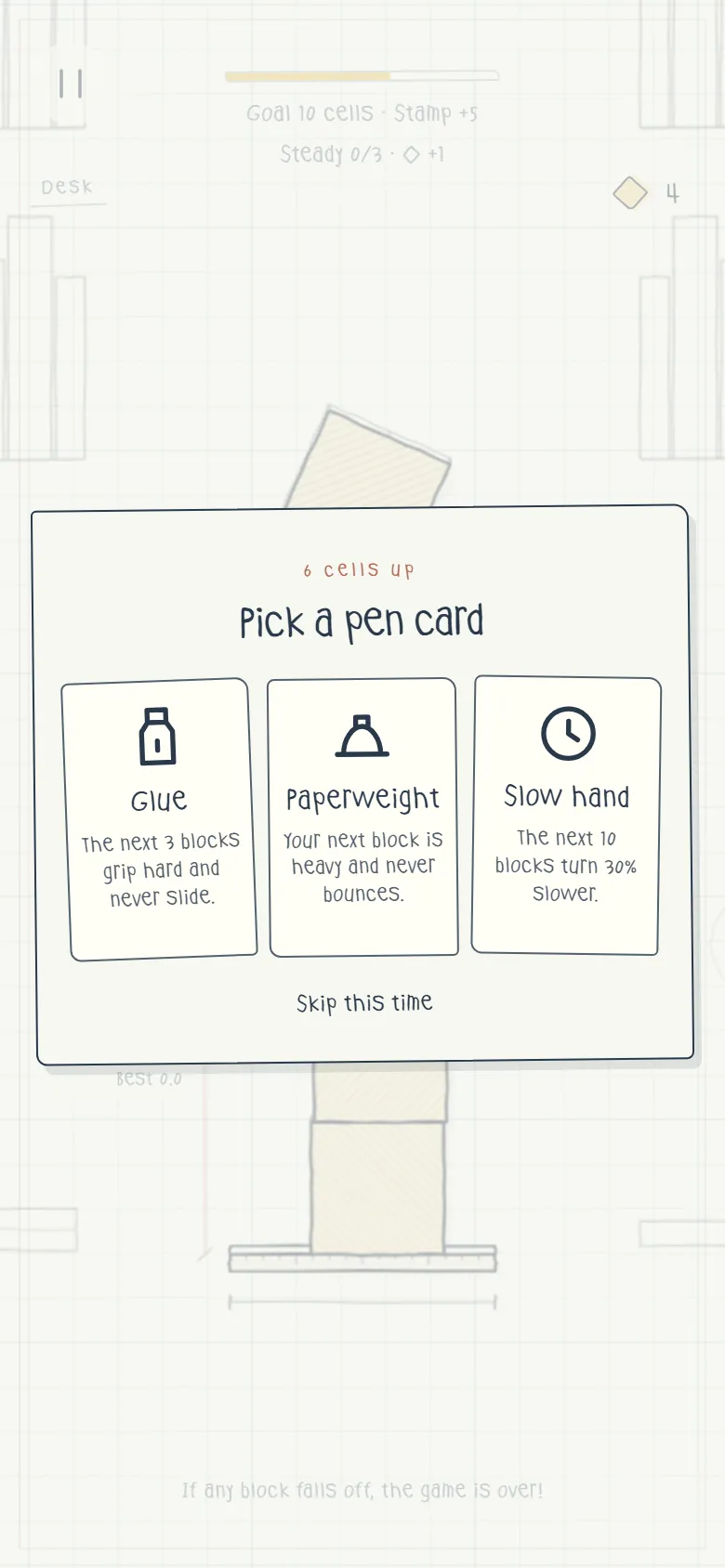
- To the sky — changes the scenery and the rules. Starting on the desk, the view changes as you climb, and every 5 cells you pick one pen card that changes the rules for this climb.
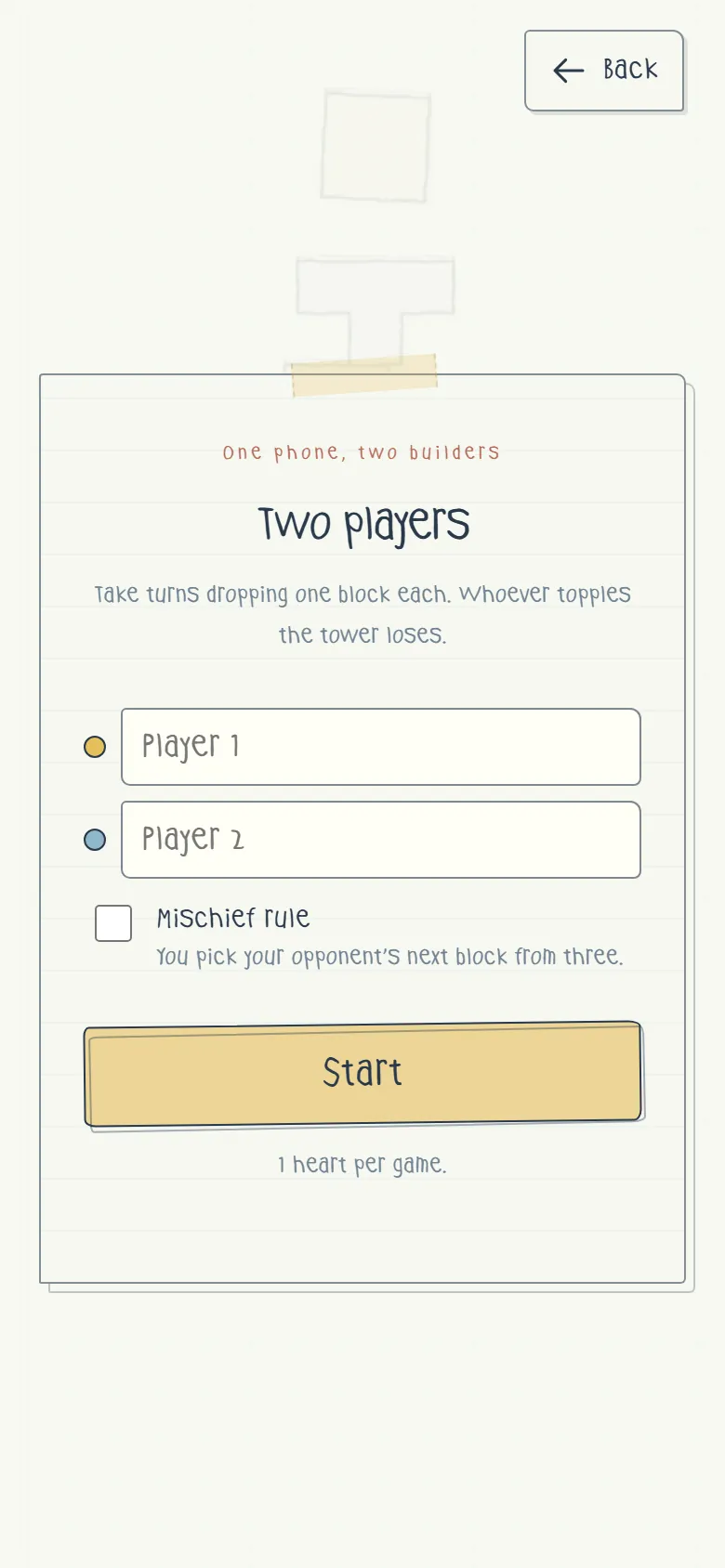
- Two players — changes the opponent. Two people on one phone take turns dropping one block each, and whoever topples the tower loses.
- R&D — changes what you stack: cars, appliances, jelly and gummy bears instead of blocks.
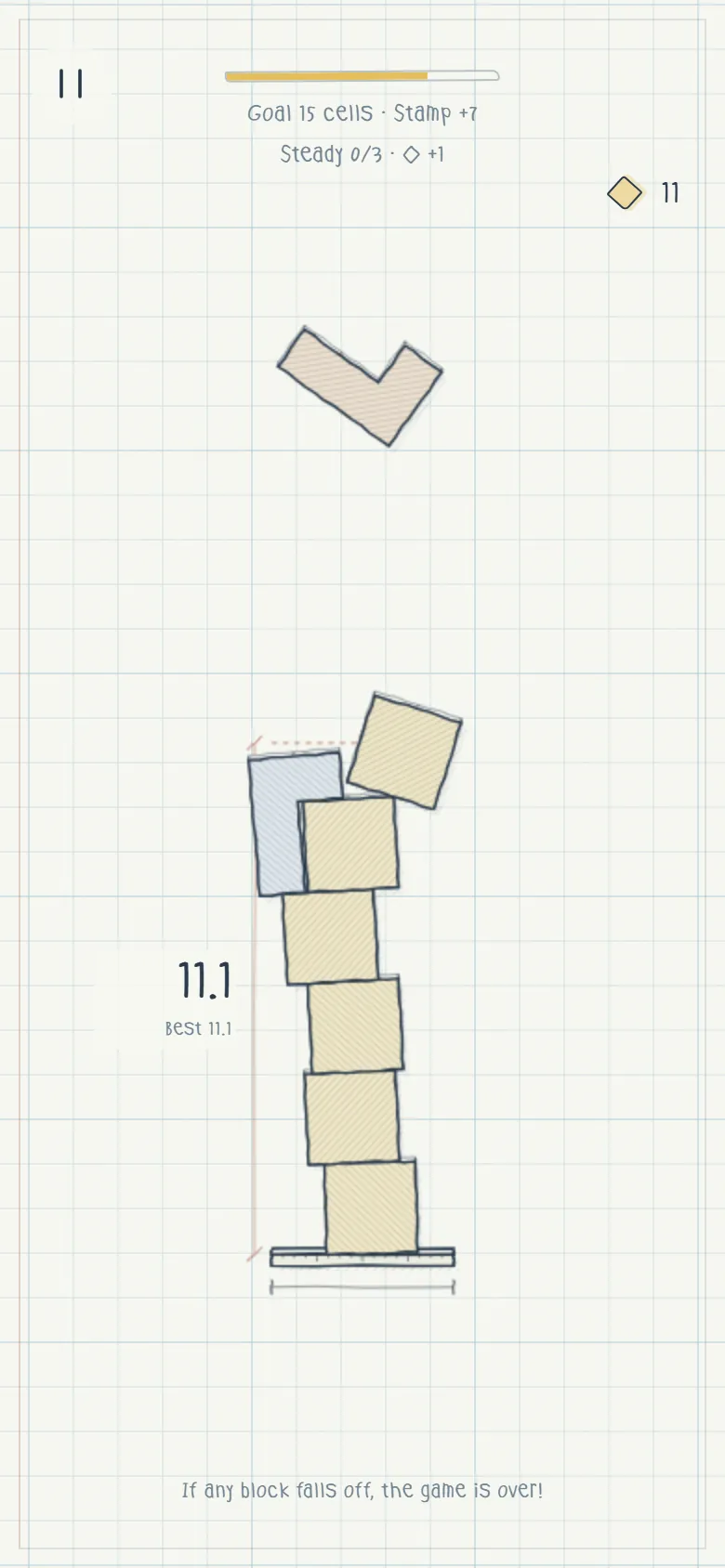
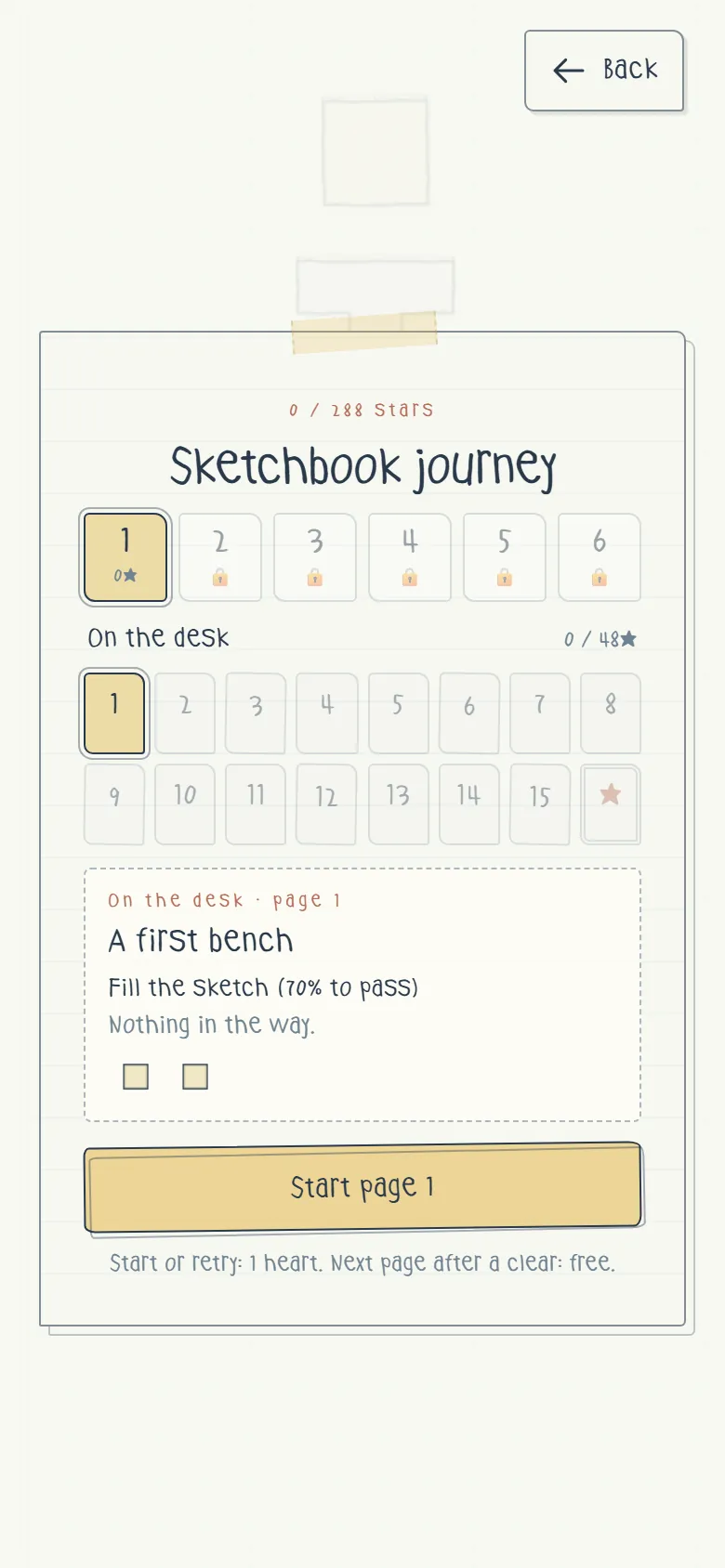
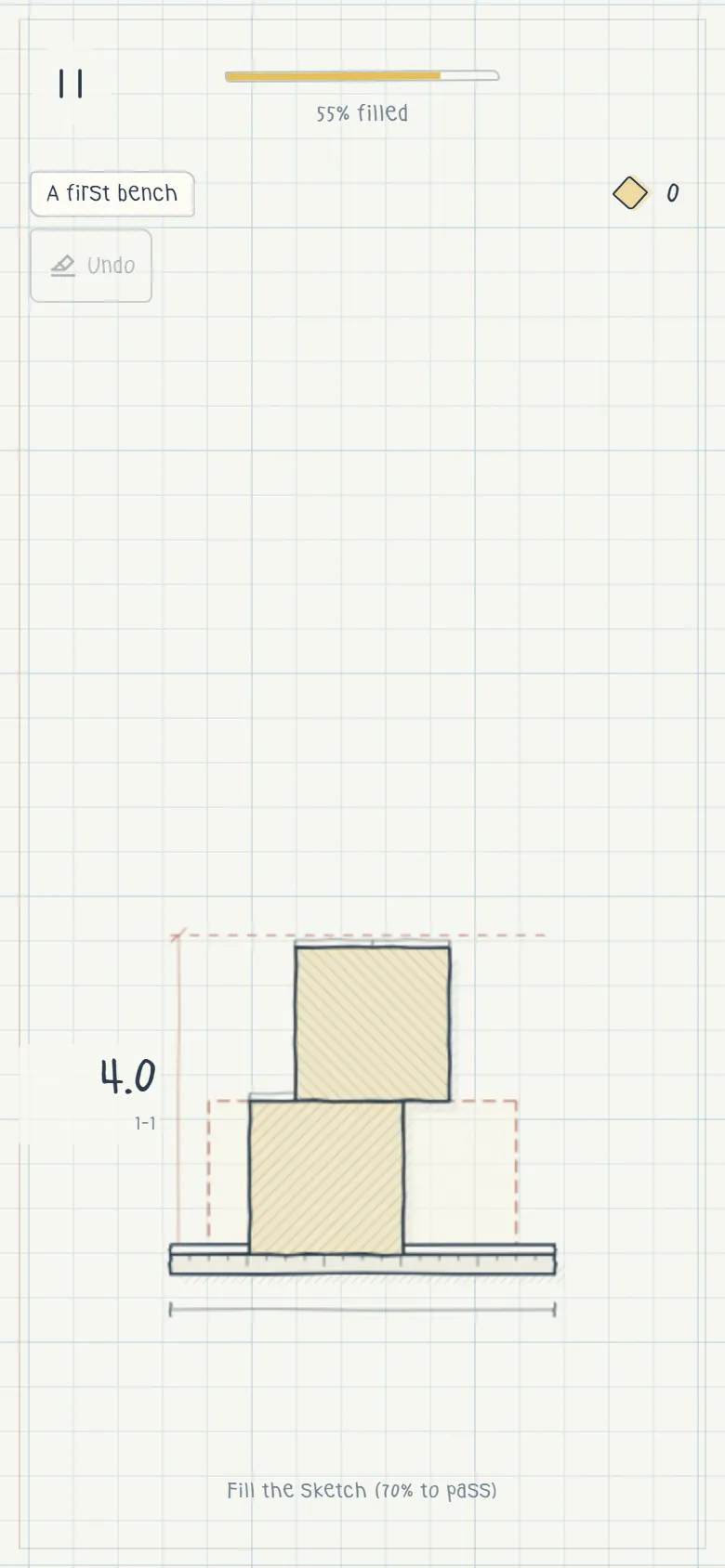
Two players has a Mischief rule. Turn it on and you pick your opponent’s next block from three. A rule where you choose the piece your opponent must place also appears in the board game Quarto (1991) (Wikipedia). The hand that protects the tower and the hand that makes life hard for your opponent move together in the same game.
From the desk, to the sky
In To the sky, the scenery changes as you climb. You start on the desk, pass the bookshelf and look out the window — seven views in all. What opens up above that, we have left off this page. Climb up and see for yourself.
There are twelve pen cards to pick from every 5 cells. Some help the tower: Glue makes the next 3 blocks grip hard and never slide, Paperweight makes your next block heavy so it never bounces, and Slow hand turns the next 10 blocks 30% slower. Others trade risk for reward: Tightrope takes a cell off the table but triples your cubes, and Gust deal brings stronger wind for double cubes. The longer you hold out, the more cards unlock.
Not just blocks
It is not just tetrominoes. Cars, home appliances and gummy bears go on the pile too.
Right now the R&D lab has Car stacking, Appliance stacking, Jelly stacking and Gummy stacking. Change what you stack and the hand changes too: cars don’t spin, so you just slide them and let go, while gummy bears spin like blocks until you hold them still.
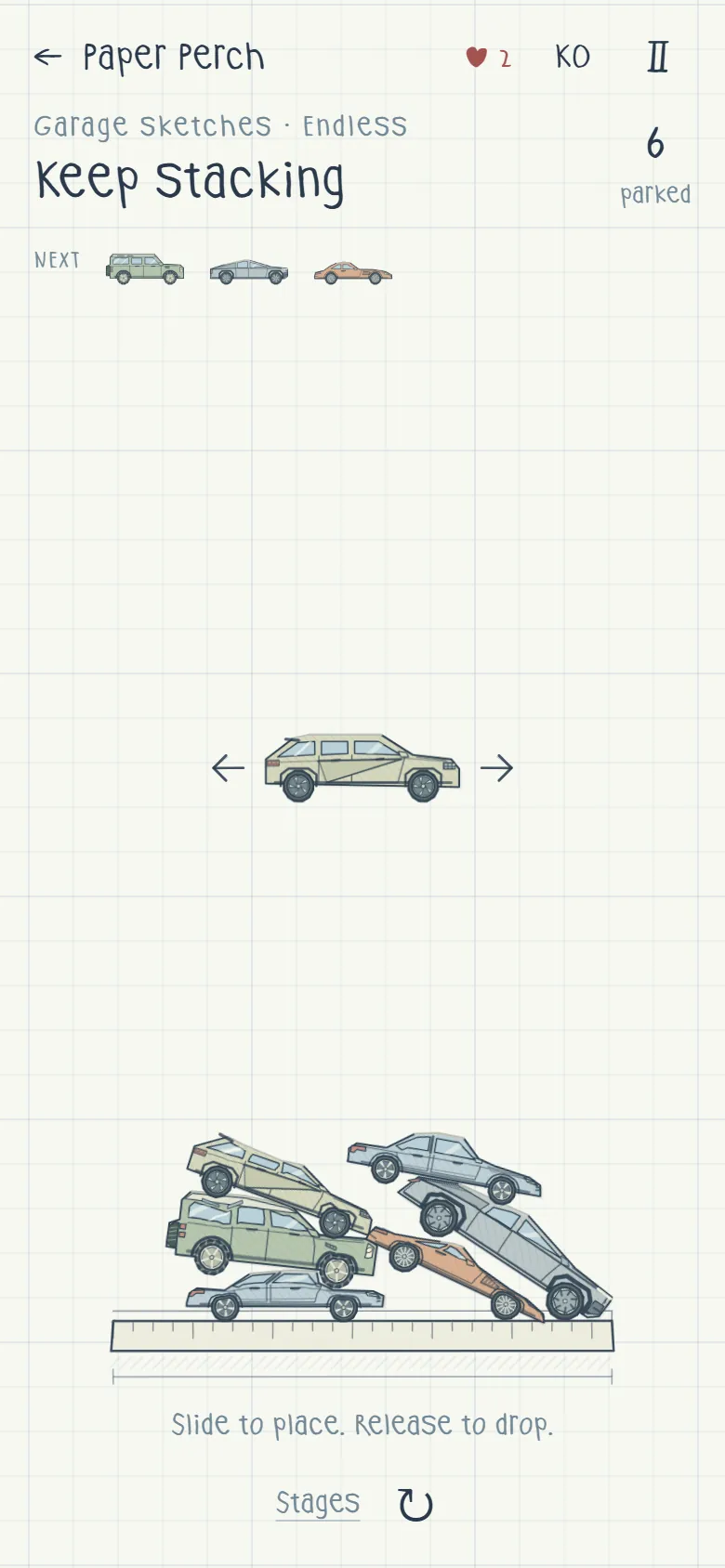
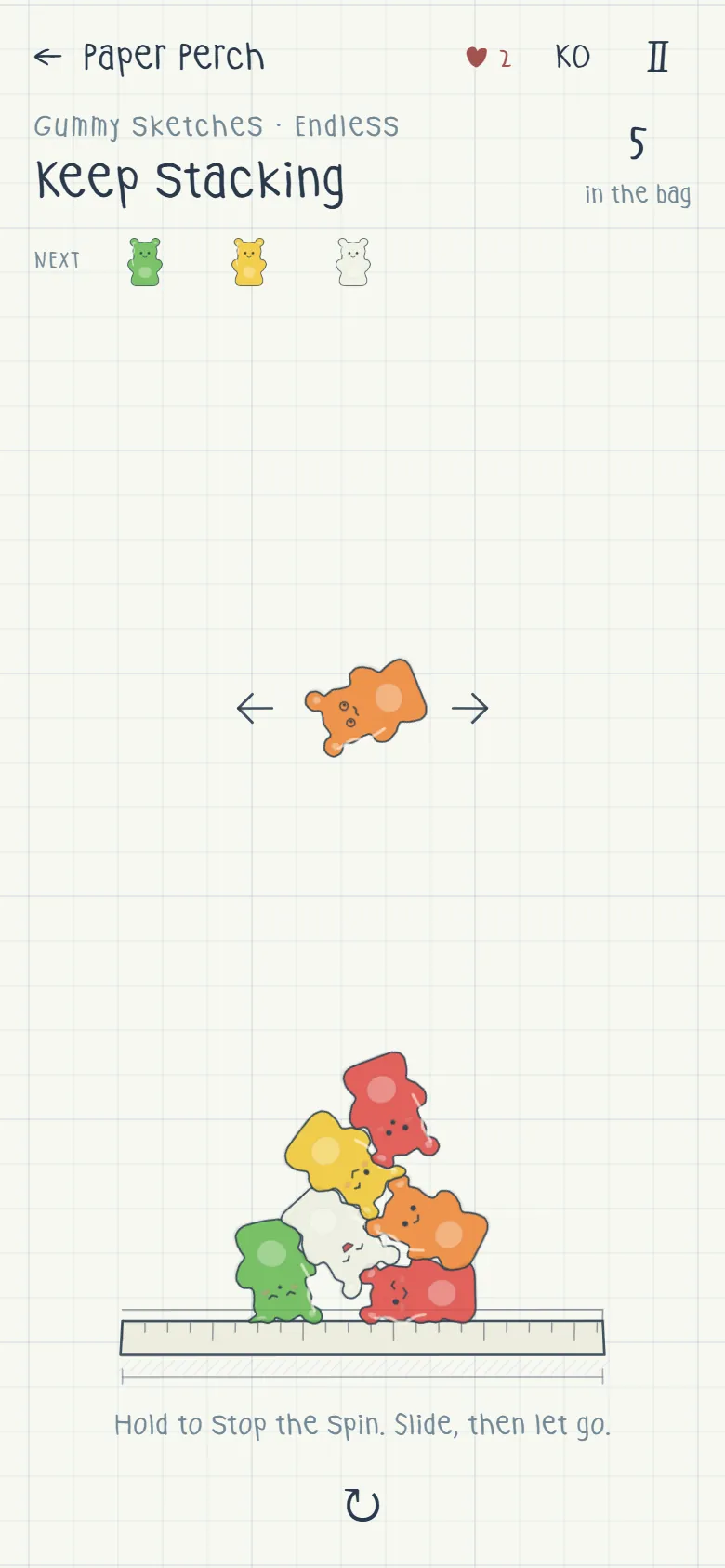
Stage designs, such as stacking high or fitting many blocks into one round, are in R&D now. In Car stacking we are also trying stages where you park a set number of cars, like ‘Room for two’.
Like a bird settling on its perch to catch its breath, we hope this becomes a place on paper where you can land for a moment and rest in the middle of a busy day.
How to play
- When the spinning block reaches the angle you want, press and hold. The spin stops.
- Keep holding and drag left or right to choose where it lands.
- Let go and the block drops. If any block falls off, the game is over!
- Reach 5, 10, 15, 20 and 30 cells for the first time to earn a stamp. Land square to the grid three times in a row for a bonus, too.
Sources — perch (Wiktionary) · Jenga (Wikipedia) · Tetris (Wikipedia) · Tower Bloxx (Wikipedia) · Tricky Towers (Wikipedia) · どうぶつタワーバトル (Wikipedia, in Japanese) · Quarto (Wikipedia) · Game screens captured from the web build, 2026-10-03