How to spot smart glasses
Smart glasses give themselves away by their frames, their recording light or the radio signals they send — and every one of those clues has limits.
There are three clues to smart glasses: how they look, the recording light and their radio signals. With more than 7 million AI glasses sold in 2025 alone, looks are harder to go by, and mods that switch off the recording light have appeared. Bluetooth and Wi-Fi signals can be heard with a phone, but they only tell you that a certain company’s device may be nearby.
Smart glasses can be spotted by their frames, their recording light or their radio signals. The first two are getting harder to trust, and the signals can be heard with a phone, but they are not proof of recording.
Why looks became the weakest clue
fact EssilorLuxottica, the maker of Ray-Ban Meta, said in its results on that more than 7 million AI glasses were sold in 2025 (EssilorLuxottica).
fact In Korea, one candidate each was caught cheating with smart glasses at the regular TOEIC sittings on and 31 May 2026. According to the TOEIC Committee of Korea they were the first such cases in the country, and both were barred from taking the TOEIC for four years (The Korea Economic Daily, 10 June 2026, Korean).
fact On another candidate was caught at Yonsei University’s essay exam for 2027 early admission. The candidate wore ordinary glasses during the pre-exam check and switched to smart glasses once the exam began. This year Yonsei’s proctors try on candidates’ glasses themselves, and the Korea Institute for Curriculum and Evaluation listed smart glasses as a banned item in its plan for the 2027 College Scholastic Ability Test (Weekly Kyunghyang, 13 October 2026, Korean).
When proctors have to try the glasses on themselves, looks have become the weakest clue. Frames and lenses can tell you no more than ‘these might be smart glasses’.
Can you trust the recording light?
fact Meta’s smart glasses turn on a white light on the side when recording. On 404 Media reported a $60 mod that switches off only that light and leaves everything else working. Anyone filmed with modified glasses has no way of knowing (404 Media).
fact Meta, whose glasses already blocked the camera when the light was covered, said in July 2026 that it would ship an update for its second-generation glasses that also turns the camera off when the light has been tampered with or destroyed. It is also removing Facebook Marketplace listings that sell light-disabling services (Fortune, 11 July 2026).
fact Snap said its glasses make a sound as well as showing a light when recording (TechCrunch, 2 March 2026).
The light is a promise set by the maker. Its shape differs from company to company, and whether it is kept depends on the device and its updates. A light says ‘recording’; no light is not a guarantee of ‘not recording’.
What is inside the signals glasses send?
Many smart glasses connect to a phone over Bluetooth. Bluetooth Low Energy (BLE) devices send short advertising signals to announce themselves before they connect, and any phone nearby can hear them.
fact An advertising signal can carry a device name, or a company number that the Bluetooth standards body (Bluetooth SIG) assigns to each company. Meta Platforms, Inc. is 0x01AB, Meta Platforms Technologies is 0x058E, and Luxottica Group is 0x0D53 (Bluetooth SIG company identifiers).
fact Nearby Glasses, an Android app introduced by TechCrunch on , listens for exactly these company numbers and alerts you when Meta or Snap devices are nearby. Its developer, Yves Jeanrenaud, said the app can also go off for VR headsets from the same company (TechCrunch).
fact Wi-Fi has similar clues. Devices that open a Wi-Fi access point, such as routers or cameras, announce a name (SSID), and the first part of a device address is a number the IEEE assigns to the manufacturer (OUI) (Wikipedia). Glasshole.sh, released in , scanned a Wi-Fi network every 30 seconds for the first digits of a Google Glass address (Infosecurity Magazine, 3 June 2014).
Looks and lights rely on human eyes, but signals are traces a device sends out on its own, so a phone can hear them.
What the signals do not tell you
- They name the company, not the product. VR headsets and other devices can use the same company number.
- Names change, and can be blank. A device name can be changed, and some devices leave it out entirely.
- Addresses change on purpose. Devices that use Bluetooth LE privacy replace the address in their advertising signals with a random value at intervals set by the maker (Bluetooth SIG). One device can look like several.
- Quiet devices stay invisible. While a device sends nothing, there is nothing to hear. No result does not mean no glasses.
- Recording is not in the signal. Who is wearing the device, which way it faces and whether it is filming right now cannot be read from an advertising signal.
A signal says no more than ‘a device like this may be nearby’. Read a clue as proof, and you end up suspecting the wrong person.
What Smart Glasses Detector shows
Smart Glasses Detector is an Android app that gathers these clues on one screen. It listens to publicly broadcast Bluetooth signals, goes on to the Wi-Fi list, and sorts what it finds into clues whose product name matches, signals for additional review that may come from ordinary devices, and unclassified signals that match no clue rule — all in one list. Tap an item to see why it was sorted that way.
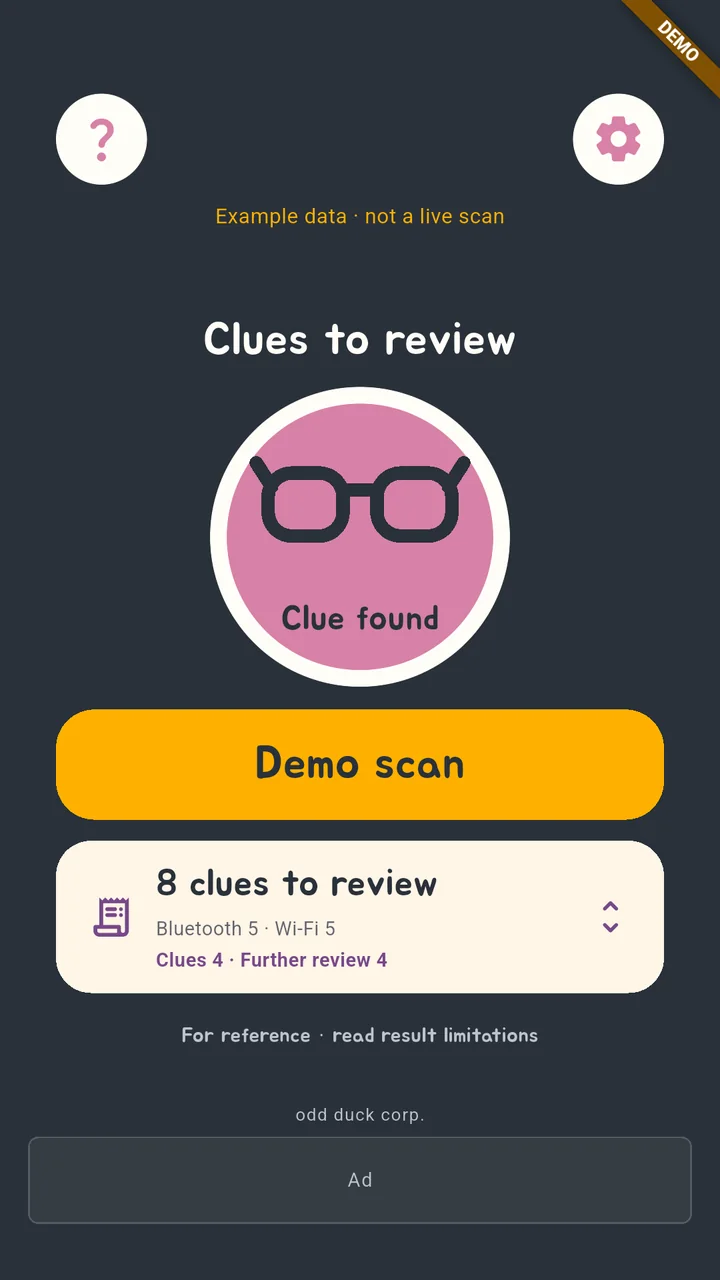
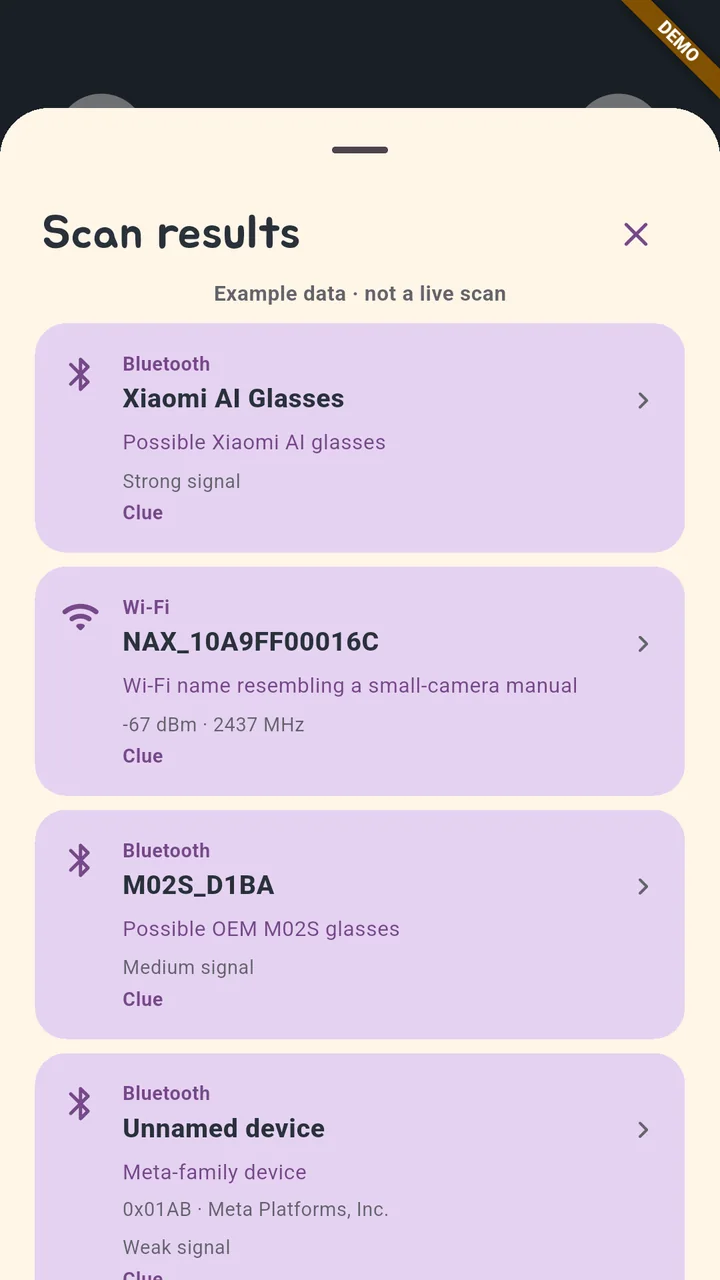
It never points a camera at anyone and does not connect to other devices. Scan results are processed only on your phone. A note that the results are for reference opens right from the main and results screens. More about the app is on its Work page, and you can download it from Google Play.
Ways of spotting glasses have moved from the eye to the light, and from the light to the signal. No clue is an answer on its own. That is why we think the job of this app is to help people read clues as clues — to take a second look rather than point at someone.