Why we made it
I once watched my nephew struggle with a cube. A few turns in, even the side you’ve already matched falls apart, and you end up putting it down more scrambled than when you started.
That gave me an idea. What if you could just take a picture and be shown how to solve the very cube in your hands? That’s where Cube at a Glance began.
We made it less to earn money than in the hope that more people could get to know the cube with ease.
The cube, in a few scenes
The cube has a long history, and more stories than anyone could count. Here we pick out just a few scenes to do with “solving” it.
In 1974, a Hungarian sculptor and professor of architecture made a cube-shaped puzzle that fits in your hand. Its original name was the “Magic Cube” (Bűvös kocka), and it first reached toy shops in Budapest at the end of 1977. By January 2024, about 500 million had been sold around the world, making it the best-selling puzzle toy (Wikipedia).
This small puzzle has 43,252,003,274,489,856,000 possible states (cube20.org). There’s a reason anyone holding one for the first time ends up at a loss.
So showing people the way started early, too. In 1981, 13-year-old Patrick Bossert published his own method as a book, “You Can Do The Cube”, and it became a bestseller. At the first world championship in Budapest on June 5, 1982, Minh Thai, a student from Los Angeles, won with 22.95 seconds (Wikipedia).
In July 2010, Tomas Rokicki, Herbert Kociemba, Morley Davidson and John Dethridge used about 35 CPU-years of computer time provided by Google to prove that any state can be solved in 20 moves or fewer. In other words, the number cubers call “God’s number” is 20 (cube20.org).
Books put the way into words, competitions raced for speed, and computers found the shortest way. Cube at a Glance shows you that way on the cube you’re holding right now.
From 22.95 to 2.76 seconds
The 22.95 seconds from the first world championship didn’t stand for long. In official World Cube Association (WCA) records, the world record for a single 3×3 solve came down into the 7-second range in 2008 and the 3-second range in 2018, and in February 2026 Teodor Zajder of Poland set 2.76 seconds. Even the record for an average of five solves is 3.51 seconds (WCA).
Faster hands weren’t the only thing cutting the times. CFOP, the method many speedcubers use today, was refined by a number of cubers in the early 1980s, and it spread widely after Jessica Fridrich of the Czech Republic wrote it up and posted it online in 1997 (Wikipedia). On the computer side, in 1991–1992 Herbert Kociemba created the “two-phase algorithm”, which quickly finds short solutions (kociemba.org). Machines are even faster than people: in April 2025, a robot built by four students in the US set a Guinness record of 0.103 seconds (Guinness World Records).
By August 2026, more than 17,500 WCA competitions had been held, and over 290,000 people had taken part (Wikipedia). Still, most people who pick up a cube never compete for records. Like my nephew, they just want to solve it all the way through, even once. We made Cube at a Glance for that one time.
Instead of algorithms, snap and follow
The most common way to solve a cube is to memorize algorithms. Instead of memorizing, Cube at a Glance has you snap, check and follow along.
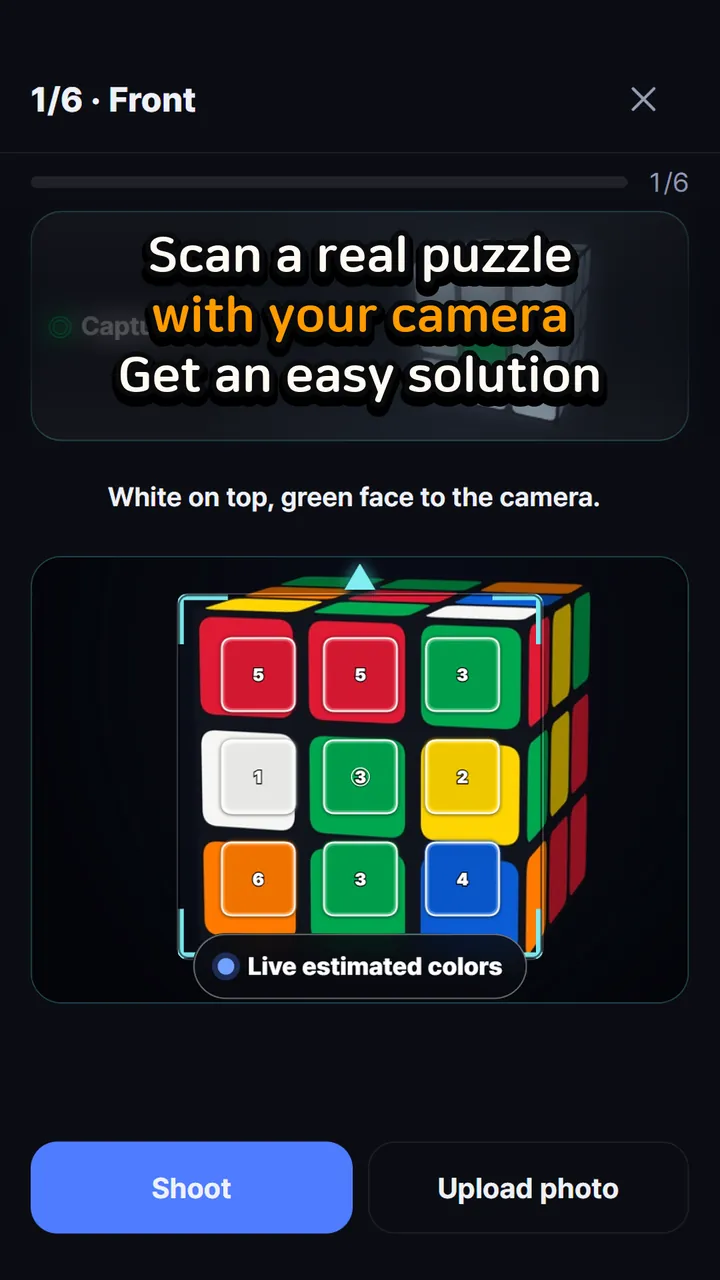
- Snap — photograph the faces one by one, following a 3D shooting guide that differs for each puzzle, and the sticker colors are read automatically. You can also enter the colors yourself.
- Check — fix any misread colors yourself; the solve starts only after the app confirms the state is actually possible.
- Follow — every move is shown with a 3D arrow, an animation and a description, in the same orientation you’re holding the cube right now. You can go to the previous or next step or use auto play, and if the cube is only slightly scrambled, it first shows a short sequence instead of a long algorithm.
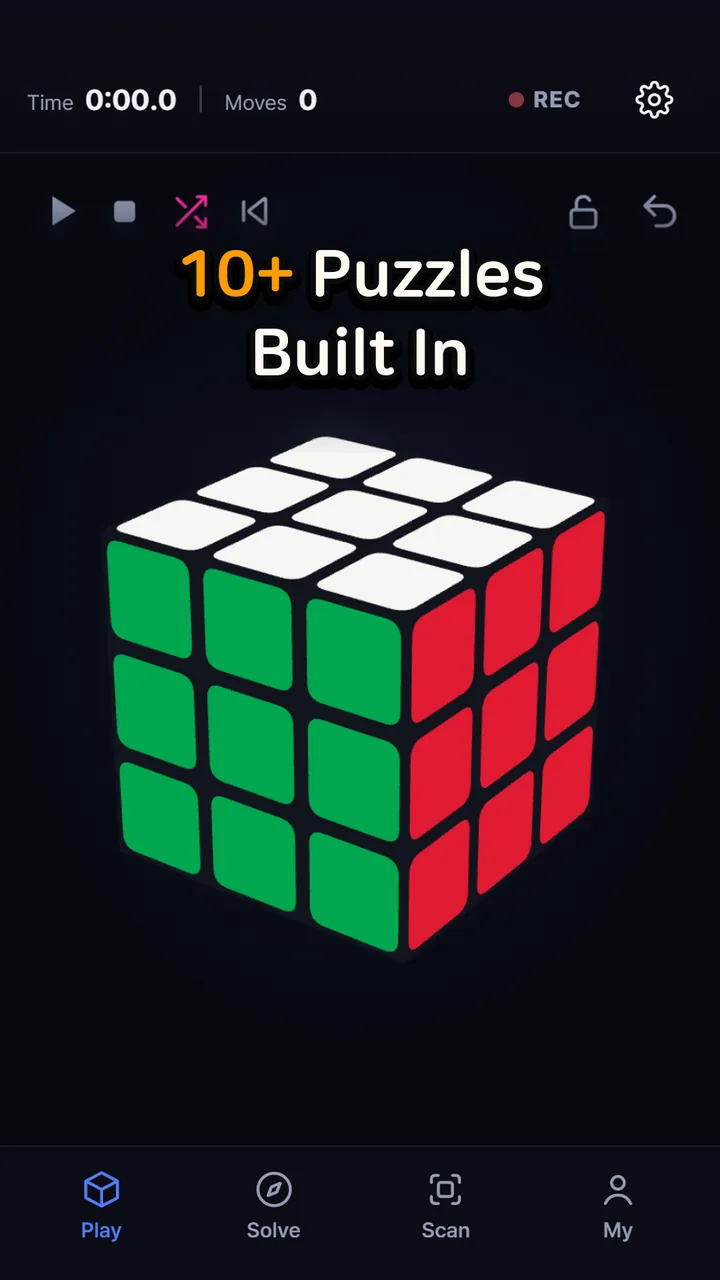
- Play it yourself — you can also turn the puzzle on screen. Scramble, timer, move count, undo, solve detection, even records.
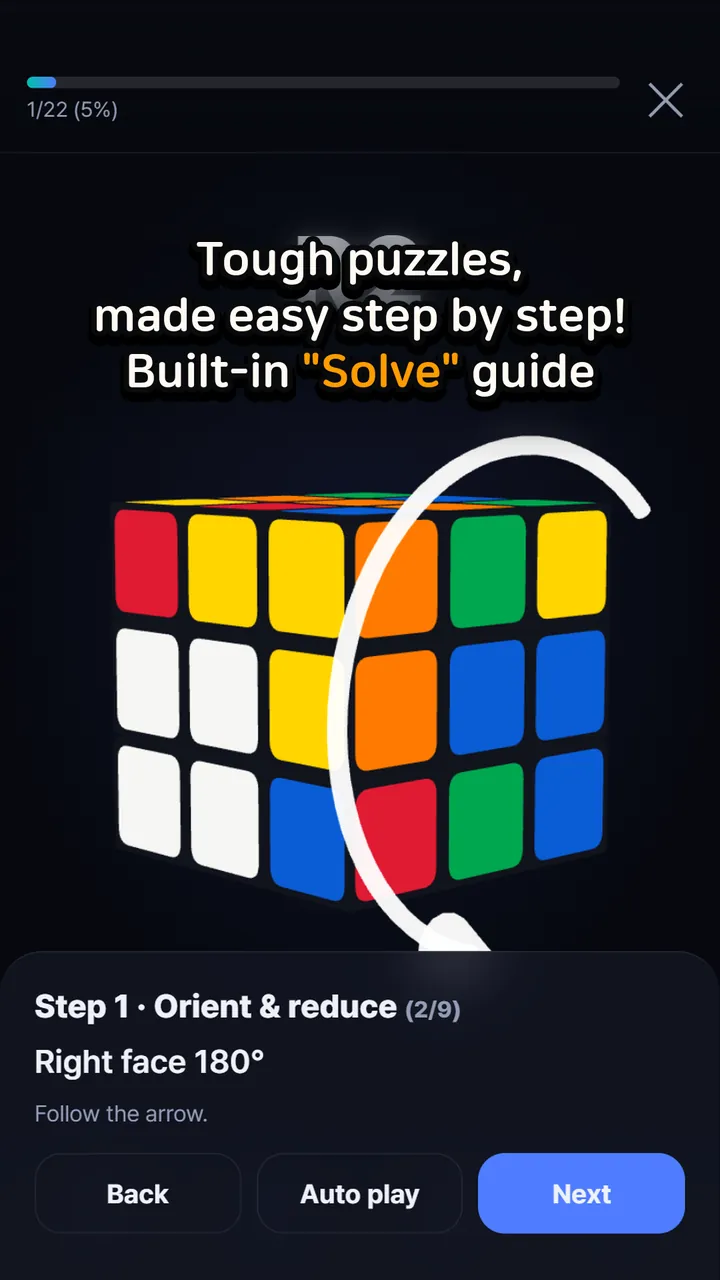
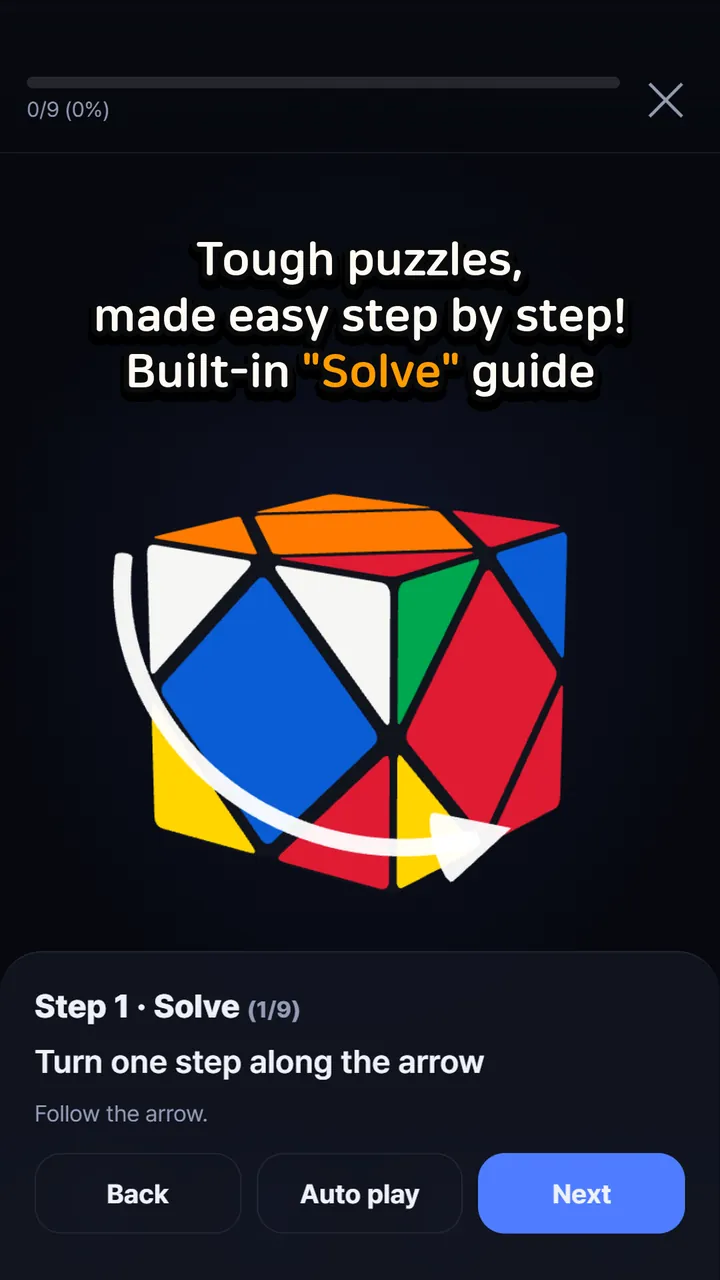
It’s not just the 3×3. From 2×2×2 to 7×7×7, plus Pyraminx, Skewb, Megaminx, FTO and Square-1, it holds more than 10 puzzles. Most are official WCA events, and FTO joins them on January 2, 2027 (WCA Regulations, WCA announcement).
| Puzzle | Shape | WCA official event |
|---|---|---|
| 2×2×2 · 3×3×3 | Cube | Official |
| 4×4×4 – 7×7×7 | Cube with more layers | Official |
| Pyraminx | Tetrahedron | Official |
| Skewb | Cube that turns around its corners | Official |
| Megaminx | Dodecahedron | Official |
| Square-1 | Puzzle that changes shape as you turn it | Official |
| FTO | Octahedron with turning faces | Official from January 2, 2027 |
The camera is used only to scan the puzzle. The captured images and the color recognition are processed on the device, and are not saved or sent off it.
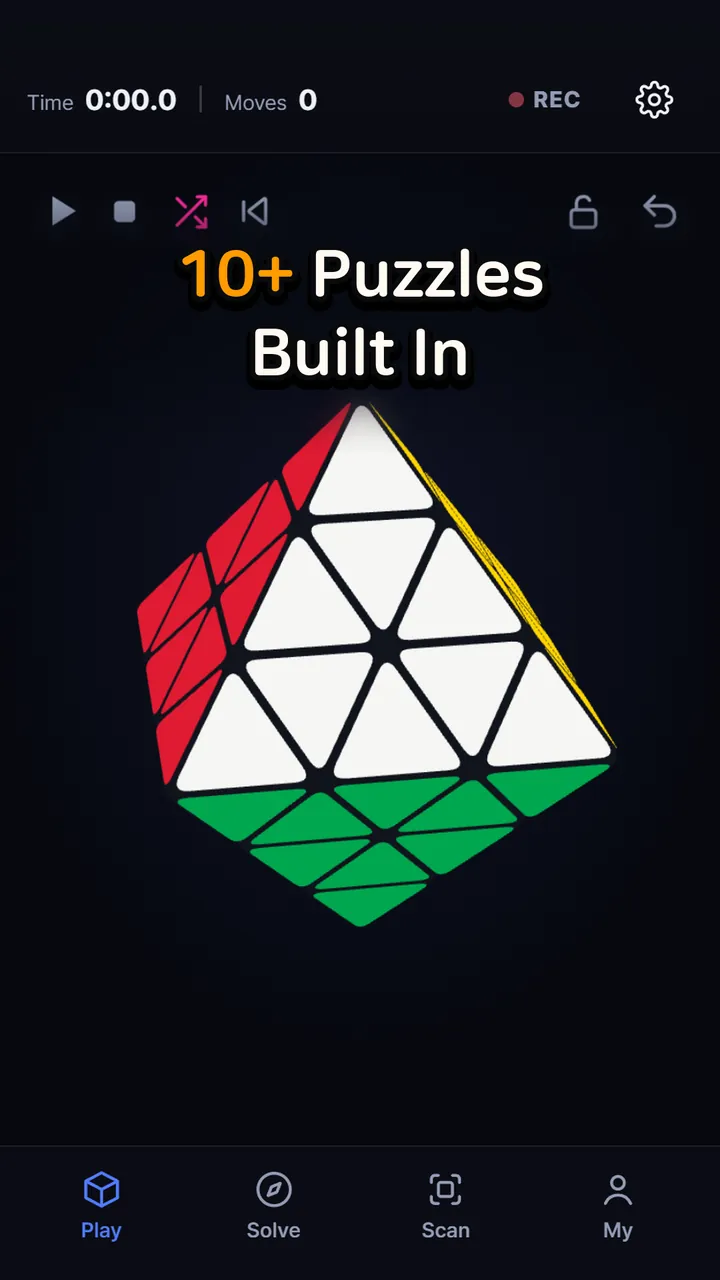 Pyraminx
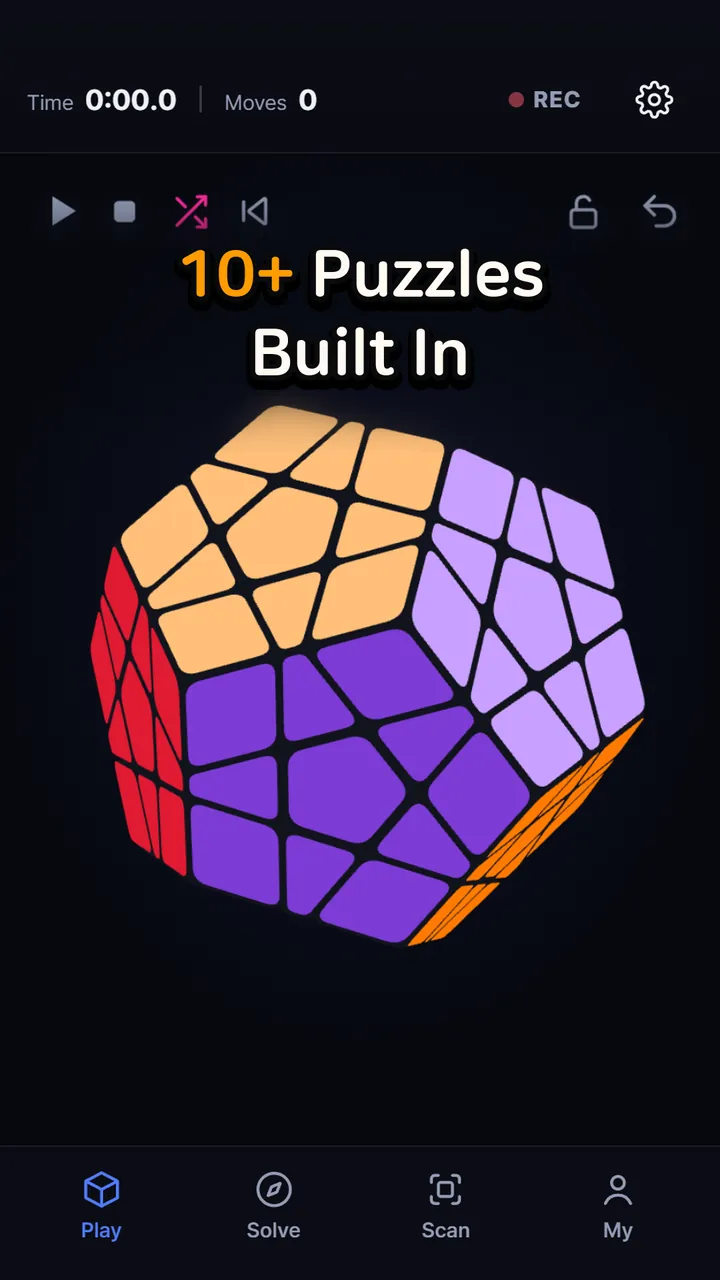 Megaminx
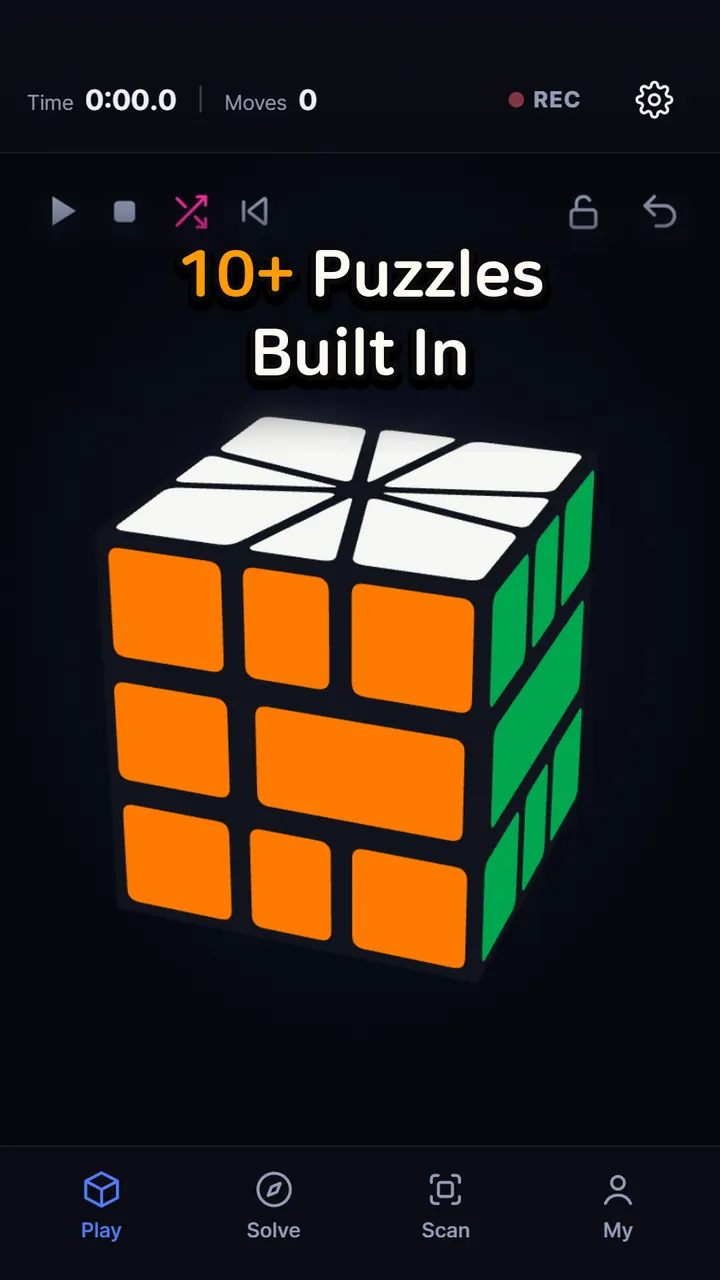 Square-1
We hope that someday, someone holding a cube for the first time, just like my nephew, gets to feel that small cheer the moment the last face comes together.
How to use it
- In Scan, photograph the faces one by one, following the guide.
- Check the colors it has read, and fix any that came out wrong.
- In Solve, turn one move at a time along the 3D arrows. You can also watch it straight through with Auto play.
- In Play, scramble, solve and time yourself.
Sources — The cube’s history, sales and first world championship (Wikipedia) · God’s Number is 20 (cube20.org) · 3×3 records and record history (WCA) · WCA Regulations — official events · Changes to the official events, June 2026 (WCA) · World Cube Association (Wikipedia) · CFOP method (Wikipedia) · Two-Phase Algorithm (kociemba.org) · Fastest robot solve (Guinness World Records) · App screens: store listing screenshots